What Is Agentic as a Service? Design-to-Code, Explained
Agentic as a service is design system infrastructure your AI agents call to generate consistent design and code. What it is, and why it matters.
Key Takeaway
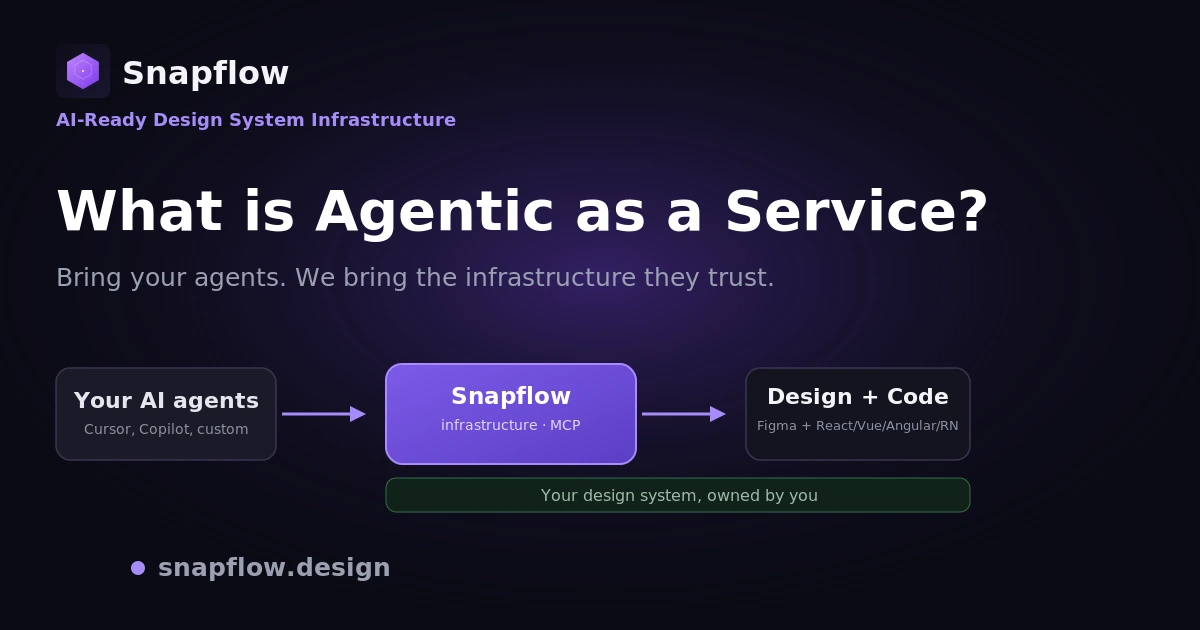
Agentic as a service is design system infrastructure, delivered as a service, that the AI agents you already use can call. Snapflow does not replace your agents. It gives them a deterministic system to read, so the design and code they generate is consistent instead of a confident guess. You bring the agents. Snapflow brings the infrastructure they can trust.
Agentic as a service is the next layer in a familiar pattern. We went from software as a service to infrastructure as a service. Now the infrastructure that AI agents depend on is being delivered the same way: as a service your agents call, not another tool you adopt. For the design-to-code pipeline, that shift matters, because an agent is only as reliable as the system it reads.
What "agentic as a service" actually means
AI agents, the things that complete tasks rather than just answer prompts, are everywhere in modern engineering: coding assistants, copilots, and custom agents teams build in-house. They are powerful and getting better. They also guess, because most of them have nothing reliable to read.
Agentic as a service is the layer that fixes that. It exposes a deterministic system through a clean interface (for Snapflow, an MCP endpoint) that any agent can call on demand. The agent stays yours. What changes is what it reads: instead of guessing your patterns, it pulls structured, deterministic context, so the same request produces the same result every time. That is the difference between a demo and a dependency.
Why the design-to-code pipeline needs it
AI is already writing frontend code in most organizations, through whatever agents your team prefers. The problem is not the agent, it is what the agent reads. Without a structured source of truth, an agent guesses your patterns from vague prompts and produces output that is almost right, the most expensive kind of wrong. Someone still reconciles it with the real system, by hand, on a Friday afternoon.
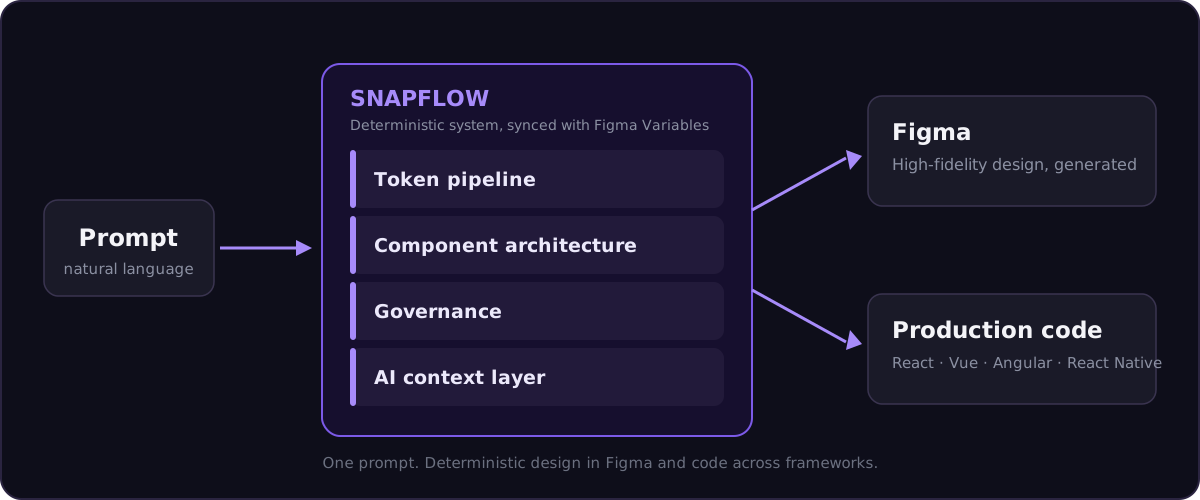
Agentic as a service fixes the input, not just the output. Instead of your agent imagining your design system, it reads one: tokens, component contracts, governance rules, delivered as deterministic context. The result is structured, on-spec generation from the first pass, with far less prompting and token waste, no matter which agent you use. That AI context layer is built, not assumed.
How Snapflow delivers agentic as a service
Snapflow exposes your deterministic design system as AI-ready infrastructure your agents can call. The flow is simple and repeatable:
- Your system is the source of truth. Tokens, variables, and component contracts are defined once and synced with Figma Variables.
- Your agent calls the infrastructure. Your coding assistant, copilot, or custom agent reaches Snapflow through MCP, no manual handoff.
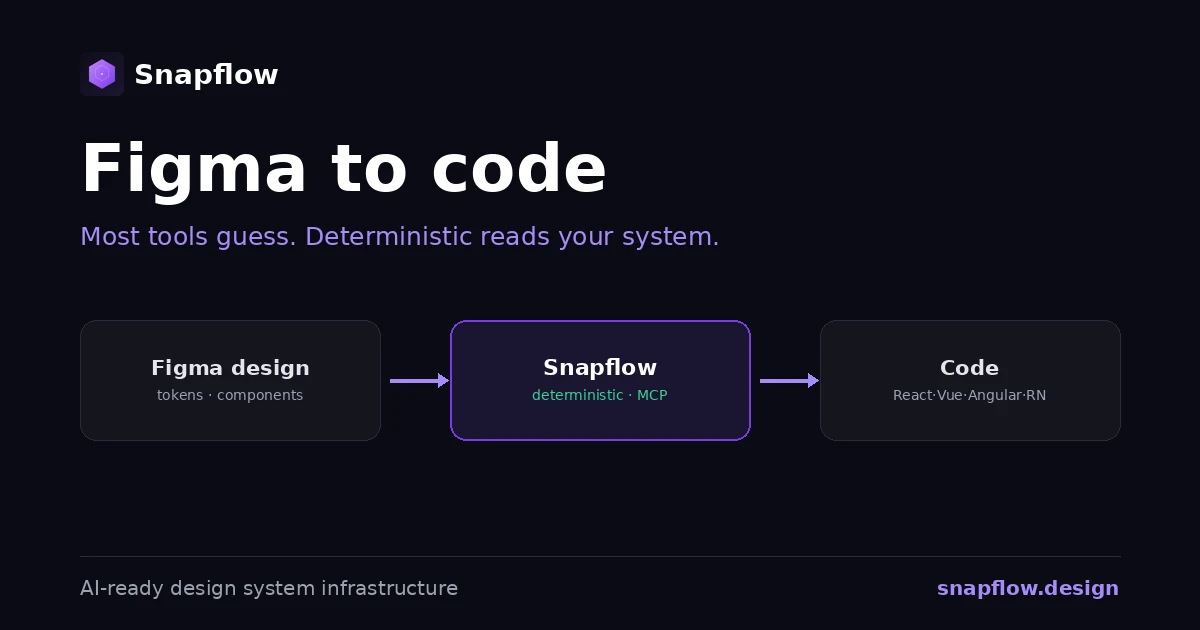
- It reads, then generates. The agent reads Snapflow's deterministic context and produces high-fidelity design in Figma and production code across React, Vue, Angular, and React Native, in sync.
- Governance holds. Rules are enforced automatically, so output stays consistent without manual review.
Work that normally takes days of design-to-code handoff is generated in 10 to 15 minutes in our demos, as both design and code. See how the design-to-code pipeline works.
The ownership model is where "as a service" stays honest. Snapflow's deterministic infrastructure is the service, delivered via MCP under license. Your agents are yours. Your design system, your components, and the code they produce are yours, perpetually. You are not renting your design system or adopting someone else's agent. You are licensing the infrastructure that makes the agents you already use reliable. See what a 90-day engagement delivers.
Your agent, with and without infrastructure
The same agent behaves very differently depending on what it can read.
| Your agent without infrastructure | Your agent on Snapflow | |
|---|---|---|
| Context | Guesses from the prompt | Reads your deterministic system |
| Consistency | Different result every run | Same input, same result |
| Output | Almost right, needs reconciling | Governed, on-spec from the first pass |
| Scope | A code suggestion | Design and code, together, in sync |
| Ownership | Output locked to the tool | Your system and output, perpetual |
The agent does not get smarter. The system it reads gets deterministic. That is the whole shift.
Who it is for, and what changes
Agentic as a service is for organizations running complex digital products who are already adopting AI agents to build them: CTOs, Heads of Engineering, Heads of Design Systems, and Design Ops leads who need AI output that is consistent, not just fast.
What changes when your agents run on real infrastructure, measured conservatively and validated in controlled environments:
- 50% less AI prompting and token waste, because the agent reads structured specs instead of guessing.
- 40% fewer handoff cycles between design and engineering.
- 90% end-to-end design-to-code consistency, by architecture, not by effort.
- 3x faster component adoption across product teams.
Every number traces to the same root: a deterministic system the agent can trust. See how we measure each one.
Frequently asked questions
What does "agentic as a service" mean? It means the infrastructure AI agents depend on, delivered through a service interface they call on demand. Snapflow delivers a deterministic design system this way, via MCP, so your agents read structure instead of guessing.
Do I use my own agent or yours? Your own. Snapflow is the infrastructure, not the agent. Bring your coding assistant, copilot, or custom agent; Snapflow gives it a deterministic design system to read.
Is this just an AI copilot? No. A copilot generates from your prompt and guesses your patterns. Snapflow is the deterministic infrastructure your copilot reads, so the same input produces consistent, governed output, design and code together.
Does it work with our framework? Yes. The output covers React, Vue, Angular, and React Native today, with more on the roadmap. The source of truth stays the same regardless of stack or agent.
Will our design system be used to train someone else's model? No. Your system is the context your agents read to serve you, not training data for a shared model. The deterministic core is what makes that possible: agents read structure, they do not need to learn your patterns.
See it run on your stack
The fastest way to understand agentic as a service is to point your own agent at your own system and watch it generate. Book a free 30-minute diagnosis: we map your current design-to-code pipeline and show you where the infrastructure plugs in, with your team's real numbers. No pitch, just clarity.
Weighing build vs. buy first? See the real 3-year total cost of ownership.
Ready to build your design system infrastructure?
30-minute free diagnosis. No pitch, just clarity on your design system state and AI-readiness.
Related Articles
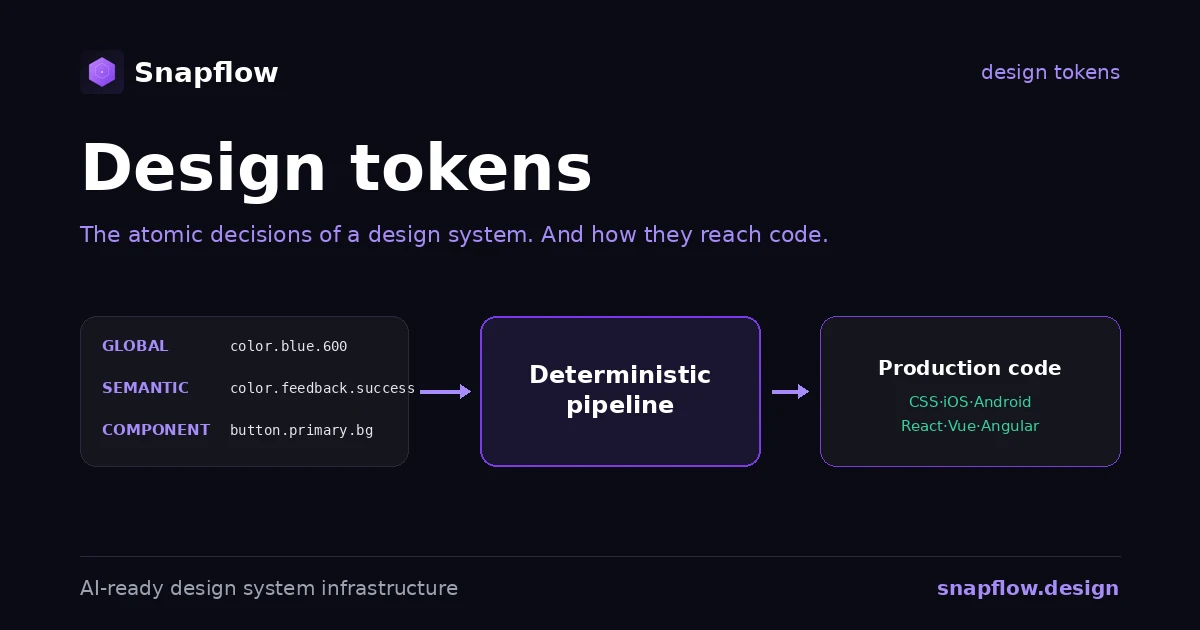
Design Tokens: What They Are, the Standard, and How They Reach Code
Design tokens explained: what they are, the three tiers, naming by intent, the new W3C standard, and the pipeline that turns a token file into production code.
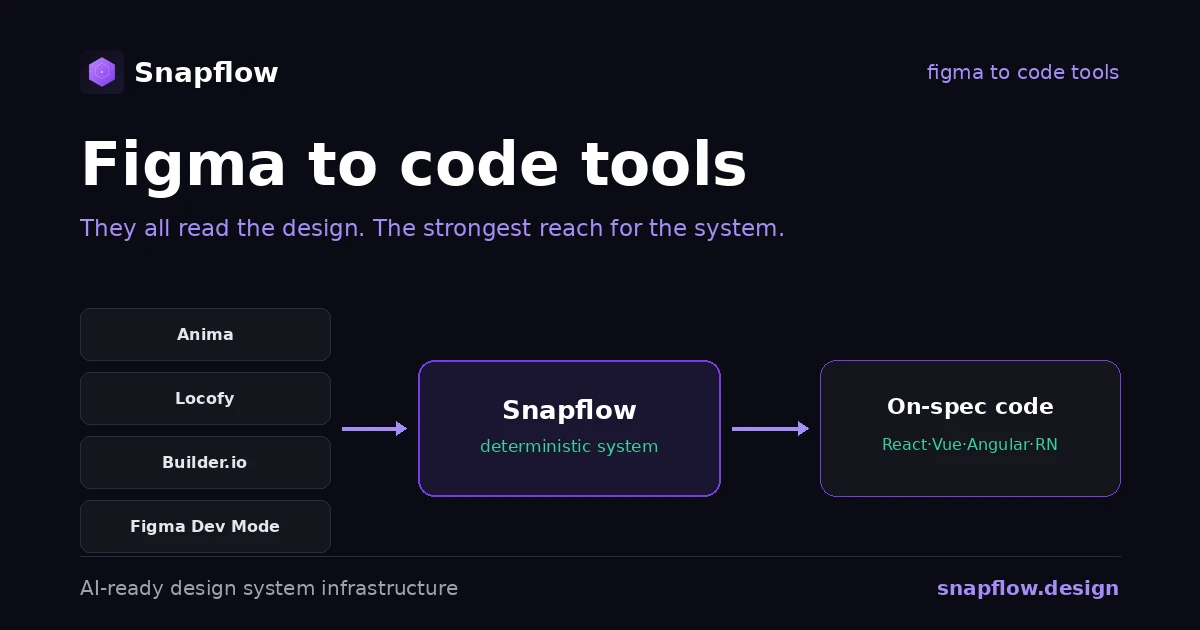
Figma to Code Tools Compared: Anima, Locofy, Builder.io, Dev Mode
An honest comparison of figma to code tools in 2026, what each one is best at, and the one axis that decides whether the output actually ships.
Figma to Code: Tools, AI, and What Actually Ships
Figma to code tools turn designs into code, but most guess. The categories, why AI generators drift, and the deterministic alternative for enterprise.